

Introduction
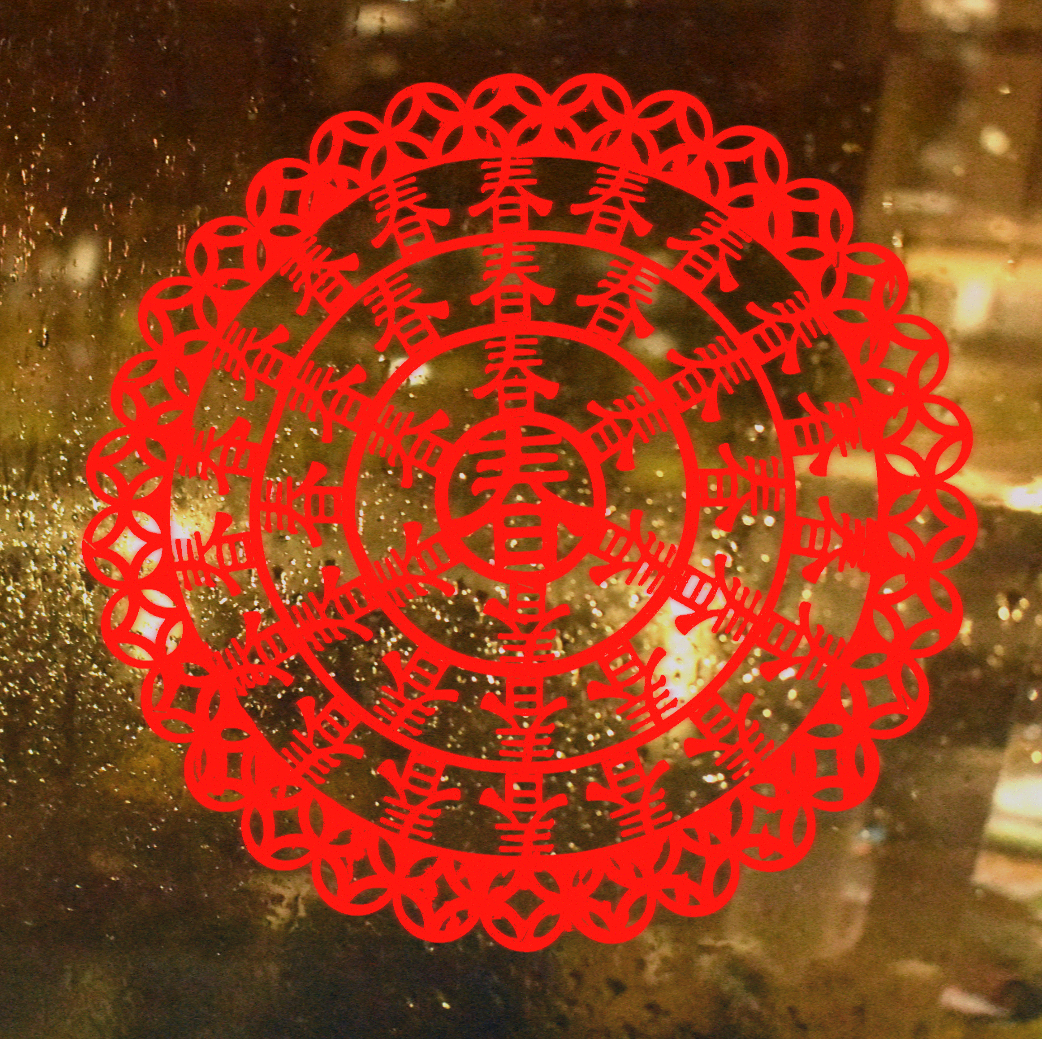
My earliest memories of Beijing are stitched from a single image: paper-thin cuttings, blood-red, carved into lace-like flowers and characters for luck. Every apartment door wore one, so that walking the hallway felt like passing through a corridor of crimson flowers.
I immigrated to the US at a very young age, where those fragile cuttings gave way to green wreaths, built to survive frost and wind and weeks on a door without wilting. Though I didn't yet have words for what I'd lost, I understood this much: I needed to hold on to the delicate scraps of red paper.
Years later, I opened a box I hadn't touched in years and found them still there, creased but intact. I began to wonder: what were these fragile scraps actually carrying, and how had they survived long enough to reach me?
01 ·
Origins of Paper Cutting
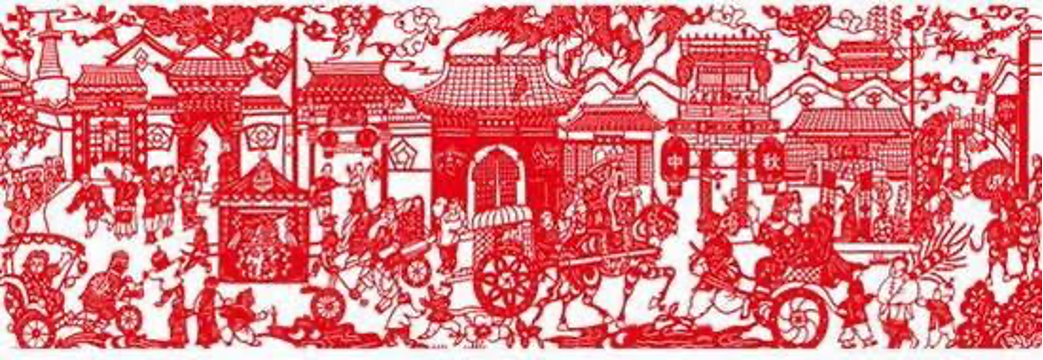
Paper cutting's roots are generally traced to the invention of paper by the Eastern Han Dynasty official Cai Lun, with the craft growing popular as paper itself became more affordable and widely available.The roots of Chinese paper cutting as an art form may date back to the time when paper was invented by Cai Lun of the Eastern Han Dynasty in China, and this art form became popular as paper became more affordable. The earliest surviving physical examples, however, come later than the invention itself: the first papercut can be traced back to the Northern and Southern Dynasties period, between 386 and 581 CE. The initiation and spread of papercutting had a close relationship with Chinese rural festivals, with people pasting cuttings on walls, windows and doors at wedding ceremonies or festivals to enhance the festive atmosphere. The craft reached a high point under the Tang dynasty; the Tang Dynasty was considered the peak of both poetry and the prosperity of paper-cutting, with more than forty surviving poems specifically describing the practice. By the Southern Song dynasty, it had professionalized further, as professional paper-cutting craftsmen have been documented as early as the Southern Song Dynasty, spanning 1127 to 1279.
02 ·
Cutting Meaning into Paper
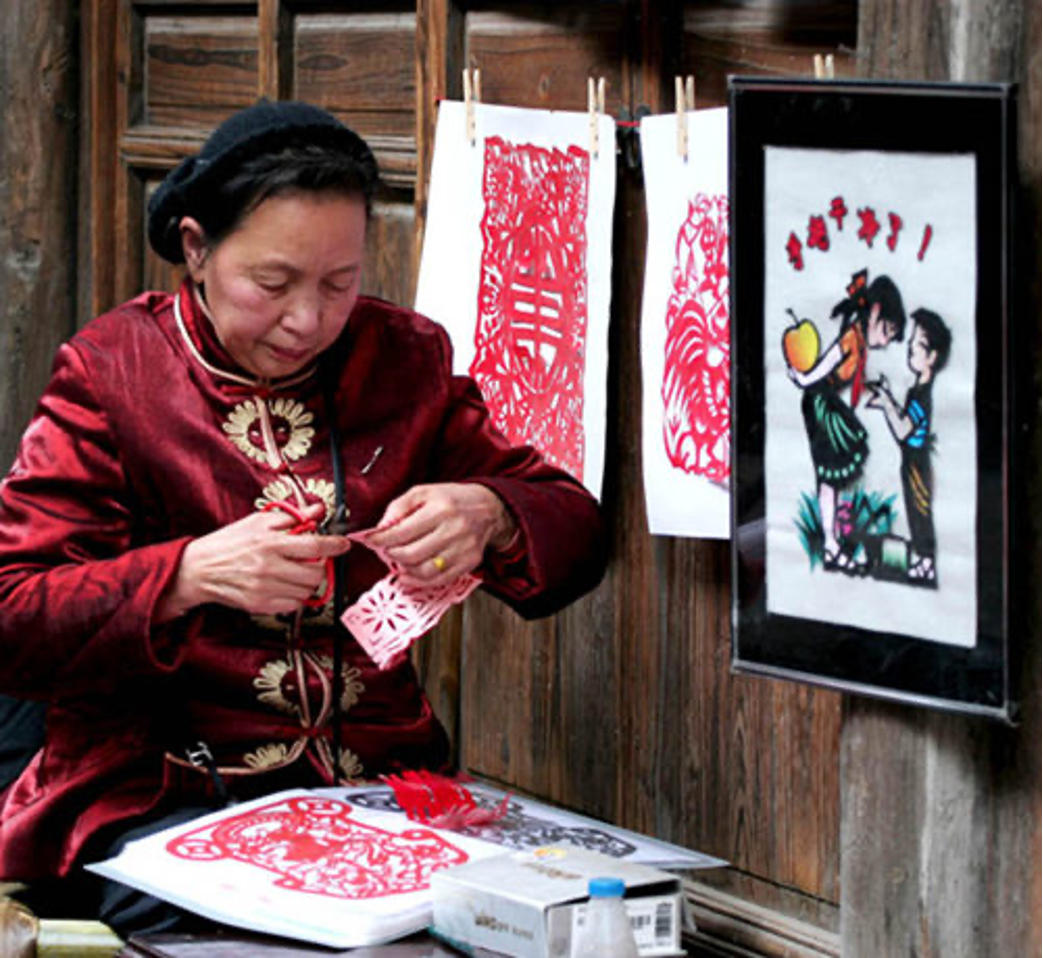
Materials and technique varied by region and era. Folk artists commonly used maobian, a calligraphy paper made from bamboo fiber, or plain newsprint, while finer traditional papers like xuan or lianshi were often colored only after the cutting was finished, and some artists even used tin or aluminum foil to imitate gold or silver leaf as decoration. Two main cutting methods dominate the craft: in scissor-cutting, several paper strips are fastened together and the artist cuts the motif with sharp, pointed scissors, while in knife-cutting, layers of paper are laid over a soft base of tallow and ash and cut vertically with a blade. Regional style is just as distinct as technique: Shaanxi window papercuts tend to be simple and bold, papercuts from Hebei and Shanxi provinces lean bright in color, while cuttings from the southern provinces are typically delicate and fine. Every motif carries layered meaning. A goldfish design signals wealth because the Chinese word for goldfish sounds identical to words meaning "gold and abundance" or "gold and jade," while a peach paired with certain characters can symbolize long life and perfection at once, letting a single image carry multiple messages simultaneously. Broader themes recur across regions as well: designs featuring a child, a lotus, or a bottle gourd traditionally suggest a family blessed with many children and grandchildren.
03 ·
A Craft Kept in the Family
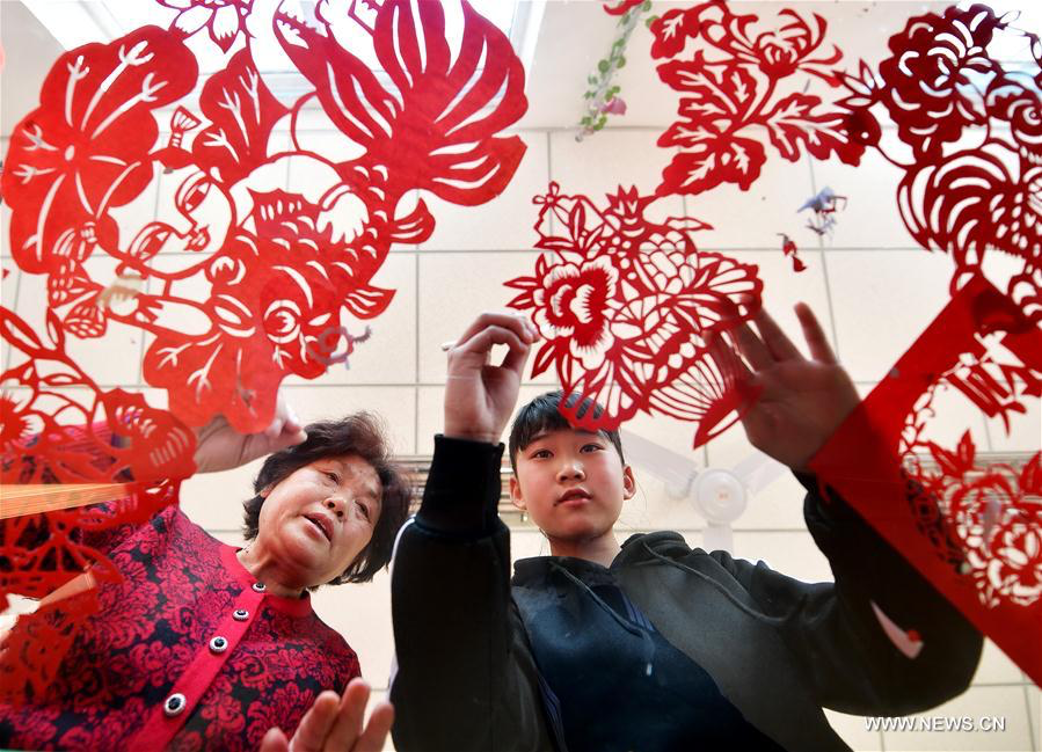
Transmission has run almost entirely through the family rather than formal instruction. Paper-cutting was originally a female dominated art, transmitted from mother to daughter over a long period beginning in childhood, and is particularly common in rural areas, where it earns the most skillful artists respect and admiration. The craft earned formal international recognition when it was included in 2009 on UNESCO's Representative List of the Intangible Cultural Heritage of Humanity. That recognition has reinforced the popularity of the art, spreading it into popular culture. Paper cutting gradually evolved and contemporary artists began to include pop culture references as well.
04 ·
Full Circle
I think about the box more than I expected to, now that I know what it's actually holding. What looked like nothing more than a childhood keepsake turns out to be a fragment of something over a thousand years old: a craft that survived dynasties, foreign invasions, industrialization, and a father with a fine blade, before it ever reached a door in my apartment building. The paper itself was not the main focus . It was always the stories behind it: a mother teaching a daughter, a daughter teaching hers, an unbroken line stretching back further than anyone could trace. Somewhere along that line, someone folded a piece of red paper, cut a shape into it they had learned from someone before them, and trusted it to outlast its own fragility. Mine has been brought in a box to a different continent than the one it was made in, a testament to the strength of this old tradition that I carry.
Research Notes
Works Cited
- International Department of Central Committee of CPC. "Chinese Papercuts." IDCPC, 25 June 2014, www.idcpc.org.cn/english2023/chinadelights/arts/crafts/202307/t20230727_157740.html.
- Los Angeles Public Library, International Languages Department. "Chinese Paper Cutting." LAPL News and Stories, 24 May 2021, www.lapl.org/news-stories/articles/chinese-paper-cutting.
- Robert C. Williams Museum of Papermaking. "Chinese Paper Cutting." Georgia Institute of Technology, 1 Nov. 2025, paper.gatech.edu/artifact/chinese-paper-cutting.
- TouchChinese. "Lucky Chinese Paper Cuttings!" TouchChinese, 23 Nov. 2015, www.touchchinese.com/learn-chinese-online/lucky-chinese-paper-cuttings.html.
- UNESCO. "Chinese Paper-Cut." Intangible Cultural Heritage, 2009, ich.unesco.org/en/RL/chinese-paper-cut-00219.
- Xinhua. "New Year Elements in China's Traditional Culture." Xinhuanet, 10 Jan. 2018, www.xinhuanet.com/english/2018-01/10/c_136884128_10.htm.