

Introduction
A history in light, music, and memory
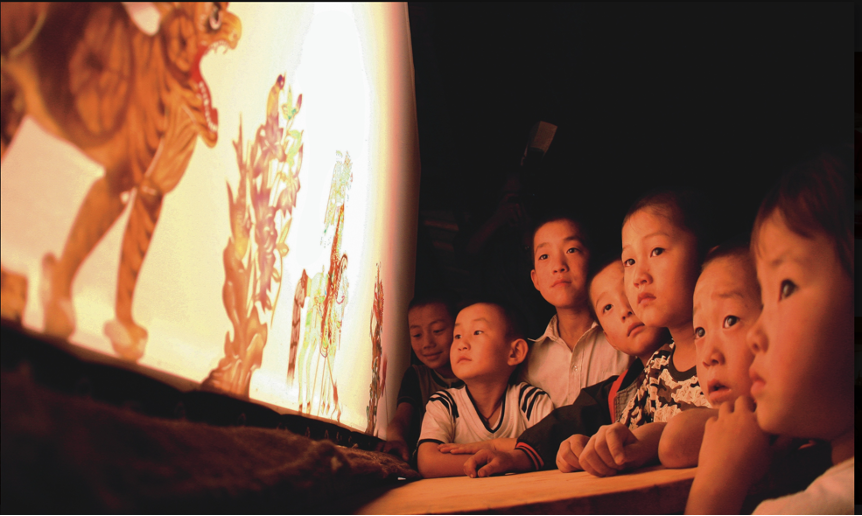
Every summer since I was five, my mother sent my sister and I to China to spend time with our grandparents in Huanxian, Gansu Province. My grandfather loved Huanxian Daoqing shadow puppetry, and he often took us to watch performances.
Born and raised in the United States, my sister and I couldn’t understand the Huanxian dialect the performers sang, but that never stopped me from being pulled into the world behind the theater. I used to run behind the screen just to watch how the artists used their rods to make those still figures come alive.
Years later, I began to ask questions: why did people create shadow puppetry in the first place? What kind of life do these stories reflect? And why is the Huanxian Daoqing style my grandfather loved different from shadow puppetry everywhere else in China?
What kind of life do these stories reflect?
01 ·
Why Shadow Puppetry Exists
Chinese folklore has many legends about shadow puppetry's origin, but from a cultural standpoint, it was not invented in a single moment by a single person. Its development was connected to several older Chinese traditions, including ancient lamp-and-shadow illusions, paper-cutting and carving, leatherwork, and folk ritual and belief.
People discovered long ago that light striking an object casts a shadow onto a wall or screen. Once figures were carved, given movable joints, and combined with storytelling, music, and singing, still shadows could become a play. By at least the Song dynasty, shadow puppetry had developed into a form of popular art. As it spread across China, each region had shadow puppets in its own dialect, music, and stories.
Before movies, television, and smartphones, a shadow screen could become a small theater. Myths and legends, wars, love and marriage, family, and stories about right and wrong could all appear in its light. Shadow puppetry was more than entertainment. It was also a way for communities to tell stories, express beliefs and values, and preserve local music and memories.
02 ·
Huanxian Daoqing's Thousand-Year Road
Huanxian Daoqing shadow puppetry is traditionally traced back to the Northern Song dynasty. Its earliest roots reach even further, to the fisherman's-drum Daoqing singing performed at Xinglong Mountain, a Daoist sacred site in Huanxian, which is a form of narrative singing born from the scripture chants of Daoist temples. That singing tradition eventually merged with shadow puppetry, developing through the Ming and Qing dynasties into the distinct Daoqing shadow art unique to Huanxian. Family-run troupes passed the tradition down generation after generation. Today, the tradition continues through around 40 shadow-puppet troupes, 300 performers, and 60 puppet carvers across Huanxian.
Huanxian lies in eastern Gansu near the borders of Shaanxi and Ningxia, a region that evolved over centuries by migration and cultural exchange. Daoqing performances were based on local beliefs and stories and became closely connected with ritual life. Voices and instruments told the story, while carved leather figures brought its characters to life on the illuminated screen.
The result was an art form that belonged not only to the performers, but also to the community that gathered to watch it.
Since the area was large and sparsely populated, an entire troupe's equipment could often be carried on one donkey, which led to the name “yi lü tuo”(一驴驮), meaning “one donkey's load.” Performers carried it from village to village, where it became part of weddings, funerals, New Year celebrations, and other traditions, allowing it to become rooted in the lives of ordinary people. With only puppets, instruments, a screen, and a light, these small troupes could create an entire theater wherever they stopped.
What interests me most about this history is not simply how old the tradition is, but how it has continued.
Last summer, I visited Xinglong Mountain and filmed with my drone without knowing its connection to the Daoqing puppetry. Only this year, while researching Huanxian shadow puppetry, did I realize that I had already stood in a place connected to the history I am currently trying to understand.
That discovery made the history feel unexpectedly personal. That is what makes shadow puppetry history meaningful: I stumbled onto the tradition before I understood what I was seeing.
03 ·
One Screen, One World
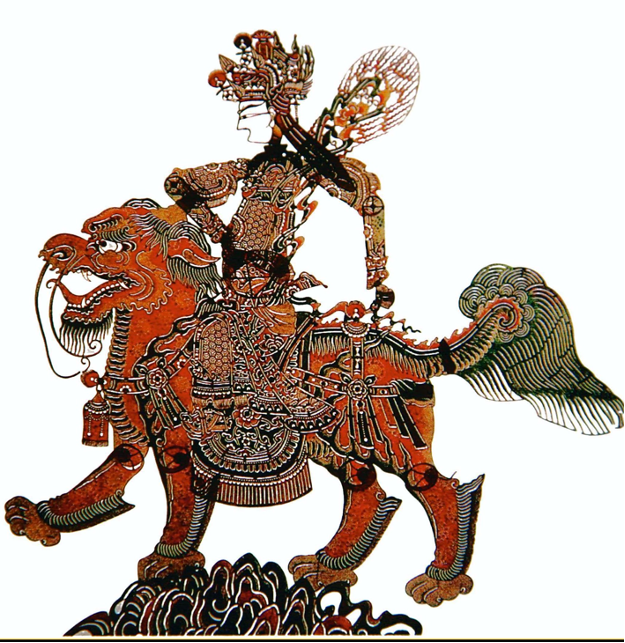
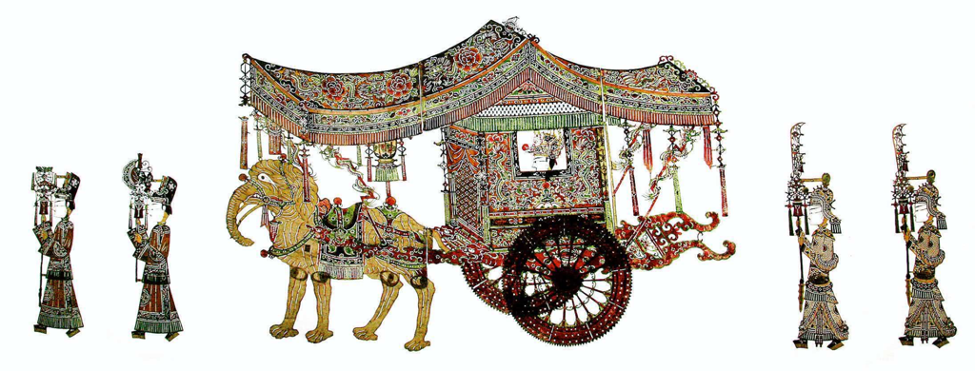
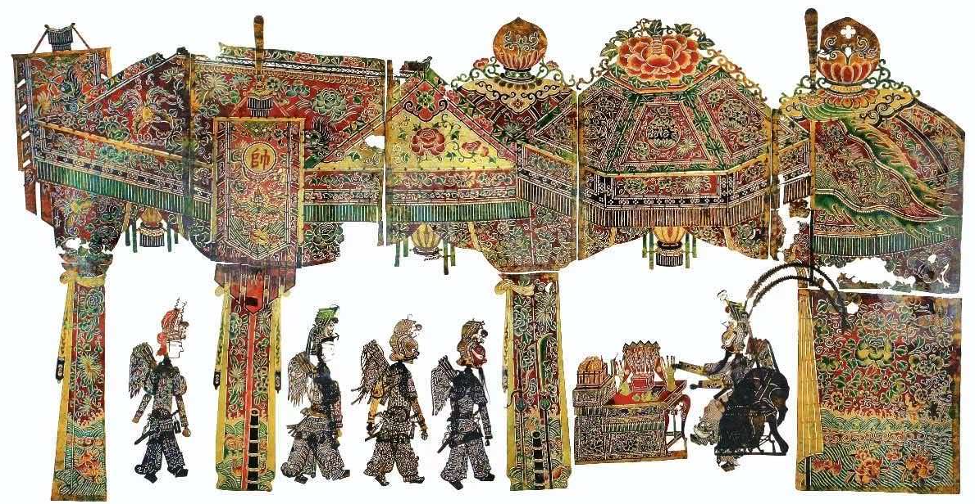
The figures themselves are already a delicate art. Traditional Huanxian shadow figures are made primarily from cowhide through a long process which includes: treating the hide, tracing the pattern, carving, dyeing, and assembling. Facial features, beards, clothing, and decorative patterns are carefully styled and carved. Different parts of the body are then connected with movable joints.
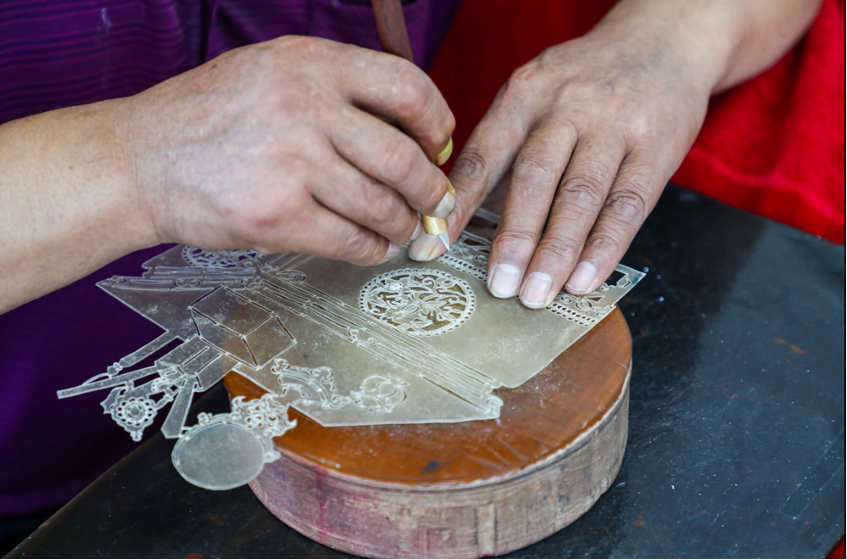
During a performance, light passes through the carved leather and projects its colors and outlines onto the screen. Puppeteers use rods to make the figures walk, turn, and fight. Combined with singing, dialogue, and music, a motionless piece of leather suddenly comes to life. This was the part that fascinated me most as a child.
In front of the screen, I saw an entire world of stories. No matter how many times I ran backstage after each show, it would amaze me that this world was being created by only a few performers, a few instruments, a lamp, and highly skilled hands.
04 ·
What Makes Huanxian Daoqing Sound Different
Many places in China have shadow puppetry, but it isn't the same everywhere. As it spreads, each region shaped its own tradition, drawing on local dialects, musical styles, and storytelling traditions — Huaxian and Huayin Laoqiang shadow puppetry in Shaanxi, Xiaoyi Wanwanqiang in Shanxi, Tangshan shadow puppetry in Hebei, Haining shadow puppetry in Zhejiang, and Huanxian Daoqing shadow puppetry in Gansu. What distinguishes the Huanxian tradition is its close connection with Daoqing music and the local culture of eastern Gansu.
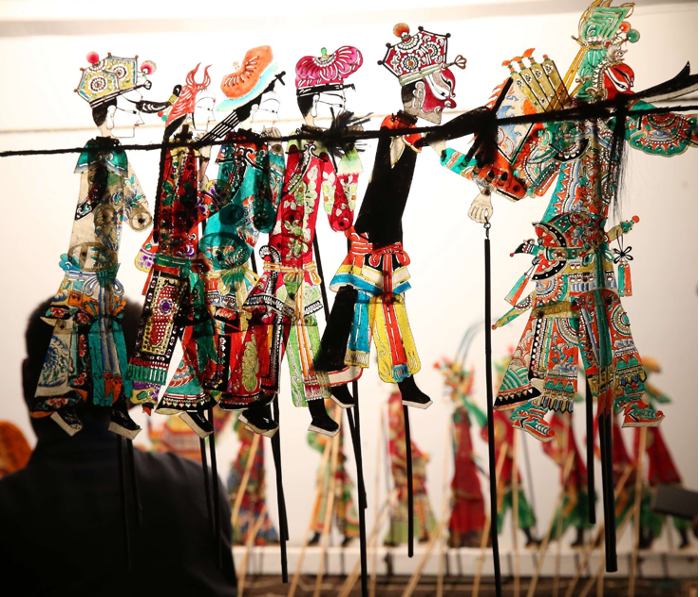
If you only watch the shadows on the screen, you're only seeing half of this art form. The other half has to be heard. Huanxian Daoqing has a distinctive sound, built around two contrasting emotional registers: huayin ("bright tone"花音) and shangyin ("sorrow tone"伤音). Huayin is to be bright and lively with celebratory scenes, while shangyin is mournful and used during sad scenes. Within a performance, artists shift between different rhythms and melodies depending on the story and the character.
Huanxian Daoqing also has a distinctive vocal form known similar to "call and response (一领众和)." In a traditional troupe, a single lead performer usually operates the shadow figures at the front while singing and speaking every character's lines; four or five performers behind him accompany the figures with traditional instruments such as the four-stringed sixian, the yugu fisherman's drum, and the jianban clappers. Together, they echo the leader with a chorus response. With only a handful of people behind a small screen, they can create armies in battles, families, and new worlds.
05 ·
The Pagoda Vigil, as I Remember It
Out of the many shadow puppet shows I have watched, there is one performance that has stayed in my mind. The singing would sound way more sorrowful. My sister and I didn't understand a single word, but we knew something terrible must have happened in the story. My grandfather told us the play was called The Pagoda Vigil (状元祭塔), connected to the famous Chinese legend of the White Snake. In the story, a son who has become a zhuangyuan, the highest-ranking scholar in the imperial examination, comes to the pagoda to honor his mother, who has been imprisoned beneath it.
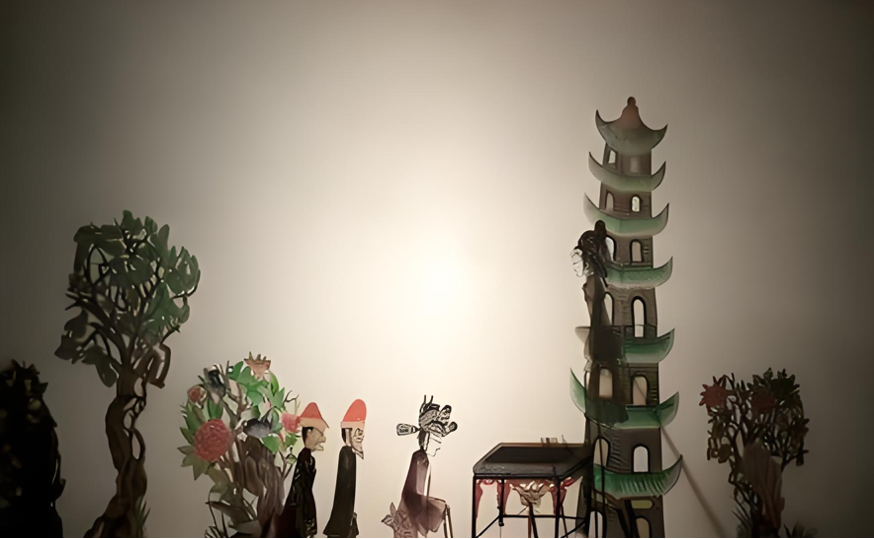
After my grandfather explained it, I cried hard. At the time, I knew nothing about huayin or shangyin. I could think of only one thing: what would I do if my mother was trapped beneath that pagoda?
We couldn't even understand the language, and yet we could hear the sorrow in the sound.
Years later, I realized something remarkable about that memory: We couldn't understand the lyrics, but we understood the feeling through the voice. The rise and fall of the voices, the rhythm of the instruments, and the movements of the figures had already communicated the emotion of the story. The childhood memory explains exactly why shadow puppetry has survived so long. An old Chinese legend passed from the shadow puppeteers to my grandfather, and through him, to my sister and I growing up in America.
06 ·
What Survives Beyond the Shadows
My grandfather passed away a few years ago. Those summers are no longer memories I can go back and add to; they are memories he already gave me. When I think about shadow puppetry now, I remember the lamp, the screen, and his voice explaining the parts of the stories my sister and I could not understand.
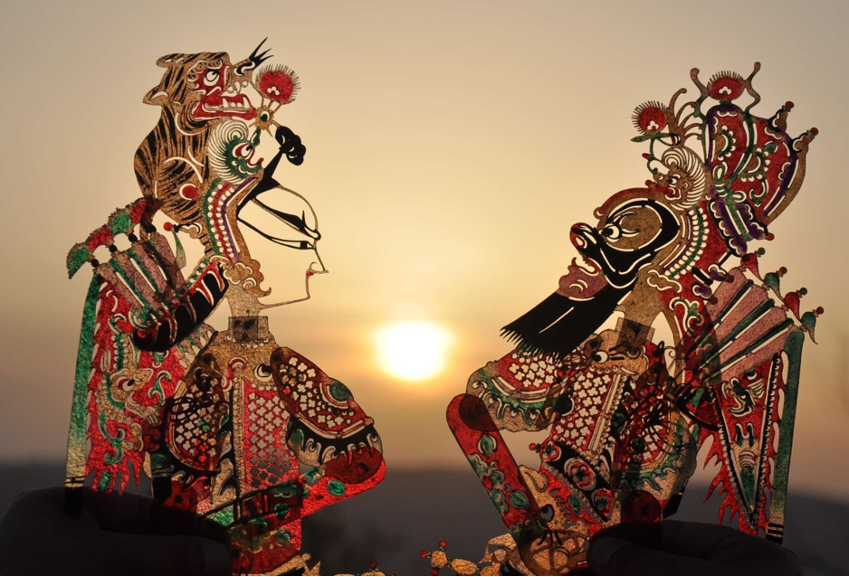
At five years old, I ran behind the screen because I wanted to know how the shadows moved. Years later, I came back to Huanxian Daoqing shadow puppetry because I wanted to understand how those shadows—and the stories behind them—continue to move from one generation to the next.
Video ·
Behind the light
Research Notes
Works Cited
- Gansu Provincial Ethnic Affairs Commission (甘肃省民族事务委员会). "环县道情皮影" ["Huanxian Daoqing Shadow Puppetry"]. Mzsw.gansu.gov.cn, Aug. 2023, mzsw.gansu.gov.cn/mzsw/c118278/202308/170359212.shtml.
- National Intangible Cultural Heritage Network (中国非物质文化遗产网). "皮影戏(环县道情皮影戏)" ["Shadow Puppetry (Huanxian Daoqing Shadow Puppetry)"]. China Intangible Cultural Heritage Digital Museum, Ministry of Culture and Tourism of the People's Republic of China, ihchina.cn/project_details/13404.html.
- "Daoqing Puppetry Steps Out of Shadows." China Daily, 6 July 2023, www.chinadaily.com.cn/a/202307/06/WS64a608ada310bf8a75d6d7d6.html.
- "Huanxian Shadow Puppets Still Dancing After 2,000 Years." China Daily, 9 Mar. 2017, https://www.chinadaily.com.cn/culture/2017-03/09/content_28486606.htm
- United Nations Educational, Scientific and Cultural Organization (UNESCO). "Chinese Shadow Puppetry." Representative List of the Intangible Cultural Heritage of Humanity, 2011, ich.unesco.org/en/RL/chinese-shadow-puppetry-00421.
- Photography courtesy of Zhao Caixia, photojournalist at Longdong Daily.